
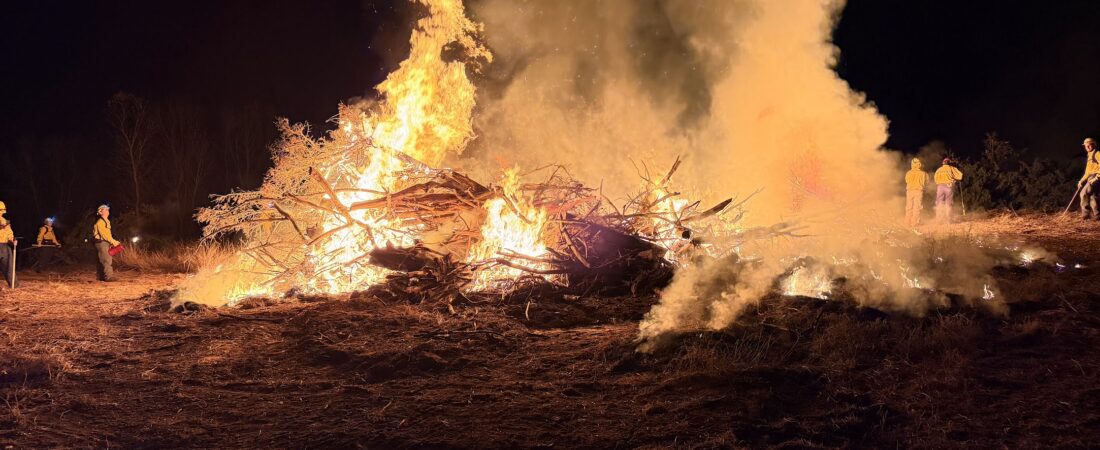
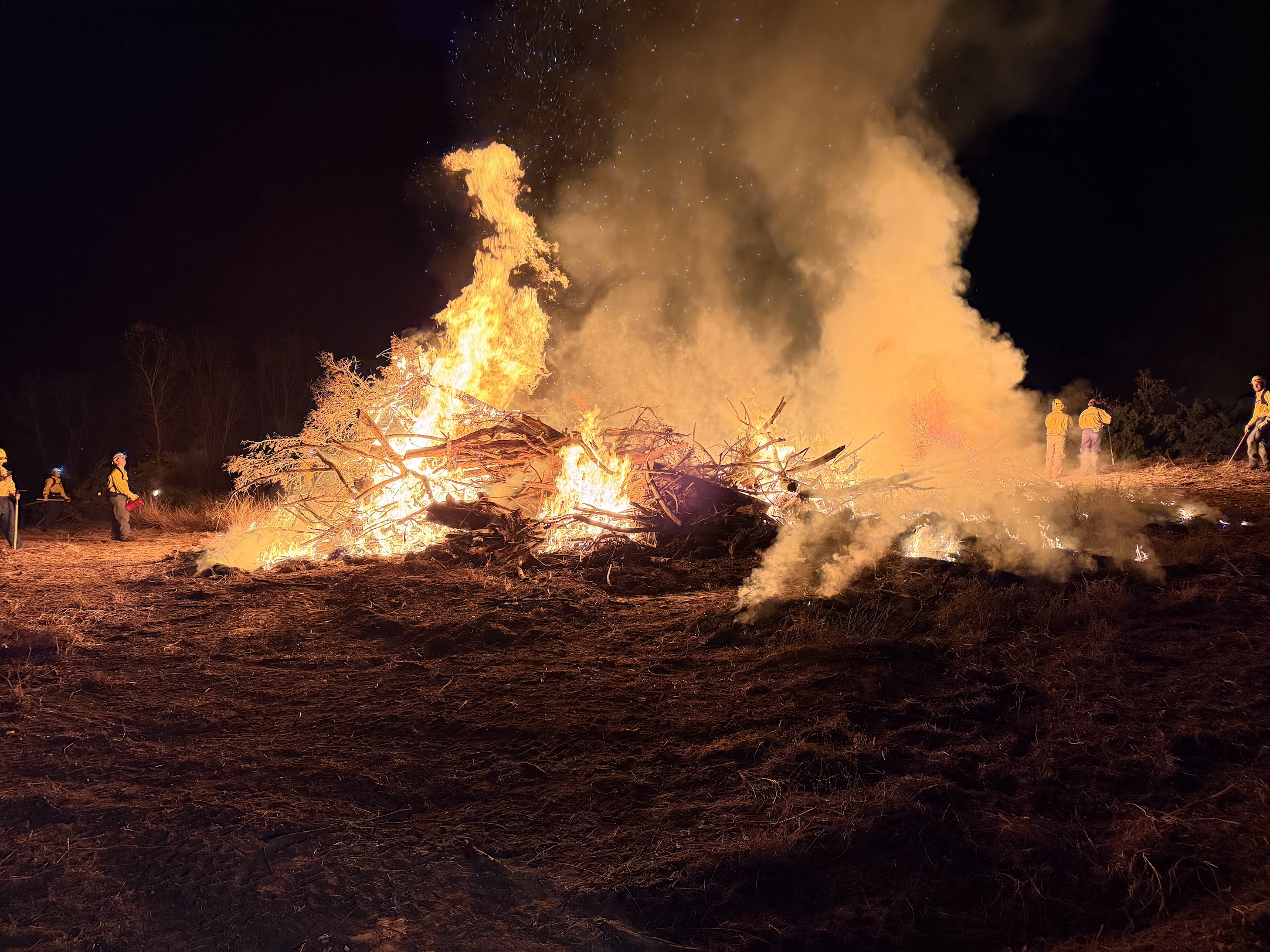
Tuesday night, SWOSU Wildland Fire Management assisted Oklahoma State Parks at Roman Nose State Park to complete a prescribed burn.
SWOSU Fire was tasked with burning several acres between golf holes at Roman Nose State Park. The first area they were tasked with burning was a grassland with mixed hardwood and cedar forest. Following the first area, they adjusted to burn an area full of slash piles that featured several years’ worth of accumulated trees and limbs. Slash piles are piles of woody debris, such as branches and stumps, left over from land-clearing projects. These piles are full of eastern red cedars, a tree native to Oklahoma that has caused many problems in recent years due to its extreme abundance. Problems caused by cedars for Oklahomans include, but are not limited to: the crowding out of native grasses, extreme water usage of the trees, loss of animal habitat, and the trees causing wildfires to become even more violent and dangerous. Such effects of cedar trees in wildfires can be seen in the March 2025 Oklahoma wildfires.
Burn operations were conducted smoothly, and the tasks presented to SWOSU Fire were accomplished. It was a late night for the crew, but critical experience was gained. I can personally attest to this, as I am a member of the group and helped out on Tuesday night.
What is SWOSU Fire?
SWOSU Wildland Fire Management, also known as SWOSU Fire, or SWOSU Fire Club, is a group for future wildland firefighters and those seeking similar professions in the field. The group is made up of students in SWOSU’s wildland firefighting associates program. This degree gives students the training and certificates needed for the job, while the “club” side of things gives students the essential hands-on experience for the field. The group participates in prescribed burns throughout the school year, although the spring is predominantly “burn season.” The group has also assisted nearby agencies with wildfires in the past.
What is a prescribed burn?
Sometimes called “controlled” burns, prescribed fires are the focus of the group and a great way to gain hands-on experience. In the simplest words, prescribed burns are planned fires that agencies will conduct to achieve a goal for land management. Diving into it deeper, prescribed burns are conducted at the land manager’s discretion and pace. They are not done at random; rather, they are done at a specific time with specific weather, wind, and resources. Resources are strategically placed and given assignments to ensure that the fire stays within its confines and accomplishes the task at hand. The weather for this burn became ideal just after sunset on Tuesday; this is a large reason why the crew conducted burn operations after dark.
What do they accomplish? (What is the point?)
As mentioned previously, prescribed burns help to accomplish a goal that land managers identify. Some of these goals include: reduced wildfire danger, improved wildlife habitat, healthier ecosystems, and the control of problem species. The difference between a prescribed burn and a wildfire is immense. A wildfire burns VERY hot, significantly hotter than a prescribed burn. This is due to the uncontrolled nature of them. The weather is often not ideal, there are no fire breaks (or lines where the fire is unable to burn past), and there is more fuel for the fire to burn. A prescribed burn helps to eliminate this fuel in a controlled environment. This means that any future wildfires in the area may struggle to be as intense or travel as fast, causing crews to be able to suppress the fire before it becomes a threat to humans, animals, or property. The lack of burns and other forest management methods has arguably led to some of the more severe fires across the country in recent years. Many people think fire=bad. Fire has been a key tool keeping ecosystems balanced for all of time, and taking it out of environments causes the wildfires that inevitably do occur to be much worse.
As for wildlife habitat and healthier ecosystems, prescribed fires are beneficial. Without diving too much into the science and specifics, essentially, prescribed fires help to open up grasslands, improve food for animals, increase plant diversity, improve soil, and much more. The thick, overgrown plants are eliminated, and sunlight can hit these grasslands again. This increases plant diversity. With increased plant diversity and the abundance of native species, this allows animals to find more habitat. A key example of this is the quail in western Oklahoma.
There is so much more science to prescribed fires and their benefits. The key point is that fire does not necessarily = bad. At least not in all cases. As the only such program in the region, SWOSU Fire is working to improve wildlife and make western Oklahoma safer one burn at a time.